Worked allowance example
The $3,000 allowance that added $4,057.
An allowance is not the final cost of a selection. This constructed tile example follows the full written cost stack: product, tax, delivery, added labor, markup, and the original allowance. That way, the contract change can be checked before approval.
Compare the final selection package to what the signed allowance actually covers.
The allowance might cover product only, or it might cover product, tax, delivery, and labor. Markup might apply to the full selection, only the overage, or not at all. A credit may follow a different rule. The written agreement controls; the example below states every assumption instead of hiding it.
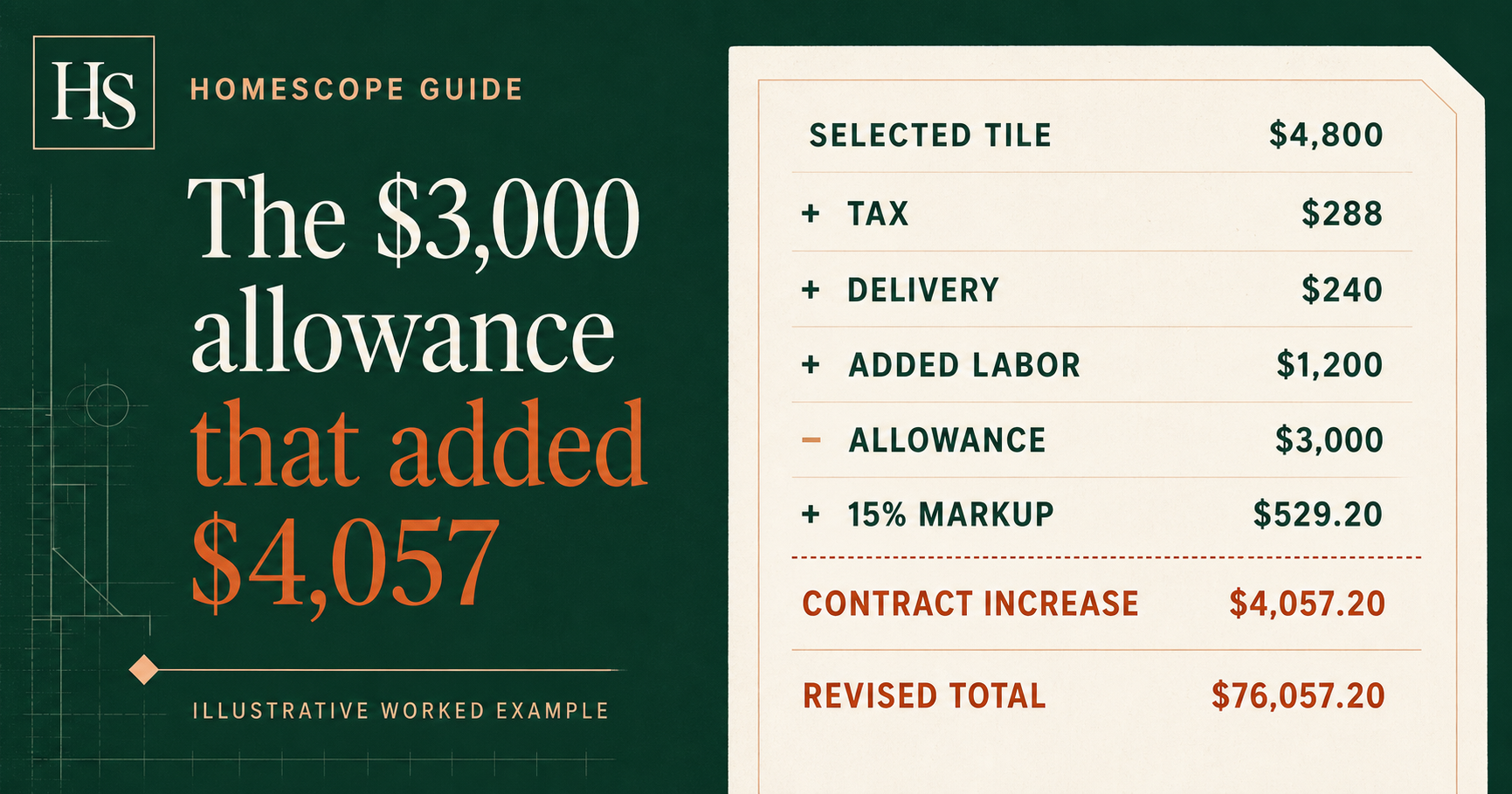
The overage is not simply $4,800 minus $3,000. The applicable tax, delivery, added labor, markup base, and credit rule must be written down first.
One signed project, one later selection
The signed total is $72,000. Then the tile is selected.
This is a constructed educational example. It is not an observed bid, Michigan cost average, legal interpretation, or recommended markup. The 6% tax line illustrates Michigan’s current general sales-tax rate; the taxable amount and contractor treatment depend on the actual transaction.
$3,528.00 pre-markup overage + $529.20 markup
The other direction matters too
A lower selection may create a credit if the contract explains how.
Suppose the selected product is $2,400, illustrative tax is $144, delivery is $100, and no added labor is required. The package is $2,644: $356 below the $3,000 allowance. That is only a theoretical credit before the written credit and markup rules are applied.
Before approving the selection
Seven lines that should be unambiguous.
Allowance basis
What exact product, quantity, unit price, tax, freight, waste, and labor does the allowance include?
Selection evidence
What vendor quote, order, or invoice supports the selection cost?
Tax treatment
Which amount is taxed, by whom, and where is it shown?
Delivery and handling
Are freight, delivery, storage, and handling included or added?
Labor effect
Does the selection change preparation, layout, installation, equipment, or schedule?
Markup formula
What percentage applies, and to which subtotal?
Credit rule
How is an underrun calculated, approved, and returned in the payment schedule?
Michigan Treasury states that the general sales-tax rate is 6% for taxable retail sales of tangible personal property. It also explains that contractors can be treated as consumers of materials used to improve real estate. This guide does not determine the tax treatment of a specific contract. Read the official Michigan source ↗
Portable selection record
Approve the arithmetic before you approve the new total.
The four-page PDF captures the signed allowance terms, selection evidence, full overage or credit formula, three-option comparison, and dated approval record. Use the same structure for cabinets, fixtures, flooring, appliances, hardware, or any other allowance.
Make the change visible
Calculate the selection before approving it.
Recreate the allowance, tax, delivery, labor, markup, and credit arithmetic from the written terms.