Annotated fictional proposal
Read the promise.
Then check the total.
Follow one fictional $48,750 kitchen estimate to see what the writing includes, what remains unresolved, and what to ask before comparing totals.
A total is the last line to compare.
First confirm the scope, exclusions, allowances, permit responsibility, payment triggers, change process, warranty, schedule assumptions, and closeout record. A lower number can represent less work, more uncertainty, earlier payments, or weaker completion terms.
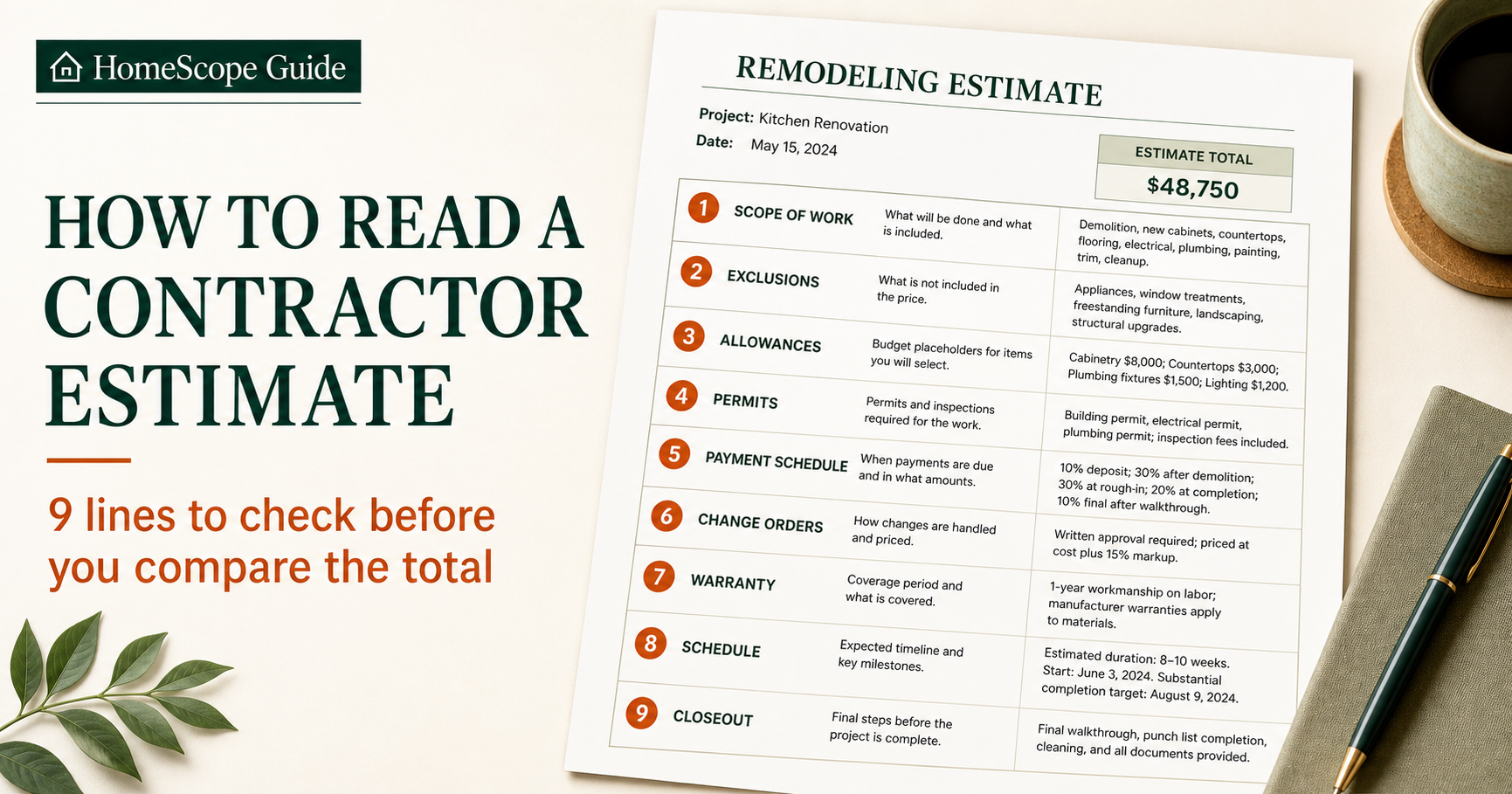
The $48,750 total is constructed for this lesson. It is not an observed bid, Michigan price benchmark, contractor recommendation, or contract.
Fictional kitchen estimate
Nine lines. Three questions for each.
Scope of work
- What the estimate says
- Demolition, cabinets, counters, flooring, electrical, plumbing, painting, trim, and cleanup.
- What it proves and what it does not
- A category list names the work, but not quantities, products, preparation, room limits, or the result that counts as complete.
- What to ask next
- Ask for room-by-room work, dimensions or quantities, product standards, preparation, installation, cleanup, and final records.
Exclusions
- What the estimate says
- Appliances, window treatments, freestanding furniture, landscaping, and structural upgrades.
- What it proves and what it does not
- Explicit exclusions prevent assumptions. The phrase “structural upgrades” is still broad if walls, openings, or concealed damage may be involved.
- What to ask next
- Ask what happens when concealed conditions or structural work are discovered, who prices them, and who authorizes them.
Allowances
- What the estimate says
- Cabinetry $8,000; countertops $3,000; plumbing fixtures $1,500; lighting $1,200.
- What it proves and what it does not
- An allowance is a placeholder, not a guaranteed installed selection. The estimate does not yet say whether tax, delivery, labor, or markup sits inside each amount.
- What to ask next
- Ask for the allowance basis, included cost components, selection deadline, overage formula, credit formula, and markup rule.
Permits + inspections
- What the estimate says
- Building, plumbing, and electrical permits; inspection fees included.
- What it proves and what it does not
- The estimate names likely permit work and who may pay. It does not prove which permits the local office requires or who schedules inspections.
- What to ask next
- Verify with the office that handles permits. Record who applies, pays, schedules, meets inspectors, corrects failed work, and keeps approvals.
Payment schedule
- What the estimate says
- 10% deposit; 30% after demolition; 30% at rough-in; 20% at completion; 10% after walkthrough.
- What it proves and what it does not
- The percentages total 100%, but several triggers are vague. “Rough-in” does not say whether applicable inspection approval is required, and “completion” is undefined.
- What to ask next
- Attach observable work, evidence, inspection dependencies, exceptions, and approval responsibility to every payment.
Change orders
- What the estimate says
- Written approval required; priced at cost plus 15% markup.
- What it proves and what it does not
- Written approval and a stated markup are useful. “Cost” still needs a definition, and time impact, credits, payment timing, and emergency work are missing.
- What to ask next
- Require original scope, changed scope, itemized costs and credits, markup base, schedule effect, payment trigger, and signatures before changed work.
Warranty
- What the estimate says
- One-year workmanship warranty; manufacturer warranties apply to materials.
- What it proves and what it does not
- A duration is named, but coverage, exclusions, notice method, response time, transferability, and the responsible party are not.
- What to ask next
- Ask what is covered, when the period starts, how to report a claim, who responds, and which product documents are delivered at closeout.
Schedule
- What the estimate says
- Estimated duration 8–10 weeks; June start; August substantial-completion target.
- What it proves and what it does not
- A planning window is useful, but estimated dates are not a recovery plan. The estimate does not name owner decisions, long-lead items, access assumptions, or delay notice.
- What to ask next
- Ask for prerequisites, major milestones, selection deadlines, known lead times, delay communication, and how approved changes revise the schedule.
Closeout
- What the estimate says
- Final walkthrough, punch-list completion, cleaning, and all documents provided.
- What it proves and what it does not
- The right categories appear, but “all documents” is not a checklist and final payment is not explicitly tied to each item.
- What to ask next
- Name punch-list signoff, final approvals, warranties, manuals, receipts, lien waivers when applicable, photos, keys, and the final-payment trigger.
First-pass completeness score
This estimate is readable. It is not ready to sign.
A completeness score does not grade the contractor or choose a winner. It shows which written decisions are usable and which need clarification before comparison or signing.
Check my actual estimate →Categories are named; quantities, products, preparation, and completion standards are not.
Several exclusions are clear; concealed and structural conditions need a written process.
Dollar placeholders exist, but the included cost stack and overage/credit rules do not.
Likely permits and fees are named; official requirements and operating responsibility remain unverified.
The arithmetic reaches 100%; milestone evidence and inspection dependencies are vague.
Useful starting language exists, but each section needs operating detail.
Send one written request
Clarify the proposal without rewriting it yourself.
Send the same organized questions to each bidder. Ask the contractor to issue a revised proposal or written addendum so the answer stays attached to the price.
- 01Attach the marked checklist.
- 02Send the same request to every bidder.
- 03Compare only the revised written answers.
Copy-ready messageProposal clarification request Thank you for the proposal. Before I compare it with other written estimates, please clarify the nine marked items in the attached checklist: scope quantities and products; concealed-condition process; allowance components and adjustment formula; permit and inspection responsibility; payment evidence; change-order cost and schedule terms; warranty process; schedule assumptions; and closeout documents.
Please include the answers in a revised proposal or written addendum and identify any effect on the total or schedule.
Portable annotation checklist
Mark the estimate before the sales call.
The four-page PDF keeps the questions and revised answers attached to one decision record. It stores no information with HomeScope.
- 01Proposal identity sheet
- 02Nine-line annotation checklist
- 03Clarification and revision log
- 04Side-by-side decision record
Continue the decision
Turn the marked-up estimate into a fair comparison.
Carry the clarified scope, allowances, exclusions, and payment terms into one side-by-side record.