Worked payment-schedule example
Pay for verified progress, not the calendar.
This constructed $96,000 kitchen-remodel example separates the deposit from mobilization, ties a major payment to rough-in work and applicable inspection approval, and keeps 5% back until closeout.
Reserves the agreement
An upfront amount due after signing, before project work begins.
Shows startup progress
A separate trigger tied to named site setup or delivered materials.
Names observable work
A defined result, rather than just a calendar date, that can be checked before payment.
Records applicable status
The actual result of a required municipal inspection, when one applies to the milestone.
Holds money for closeout
A final portion kept until agreed corrections, approvals, and records are complete.
Every payment needs an amount, a trigger, and proof.
“Week four” is a date, not proof of progress. A useful schedule names what must exist before money is due, who confirms it, which exceptions remain, and what happens when work or an inspection is incomplete.
Already reviewing the proposal? Read the estimate line by line, then check its payment stages before signing.
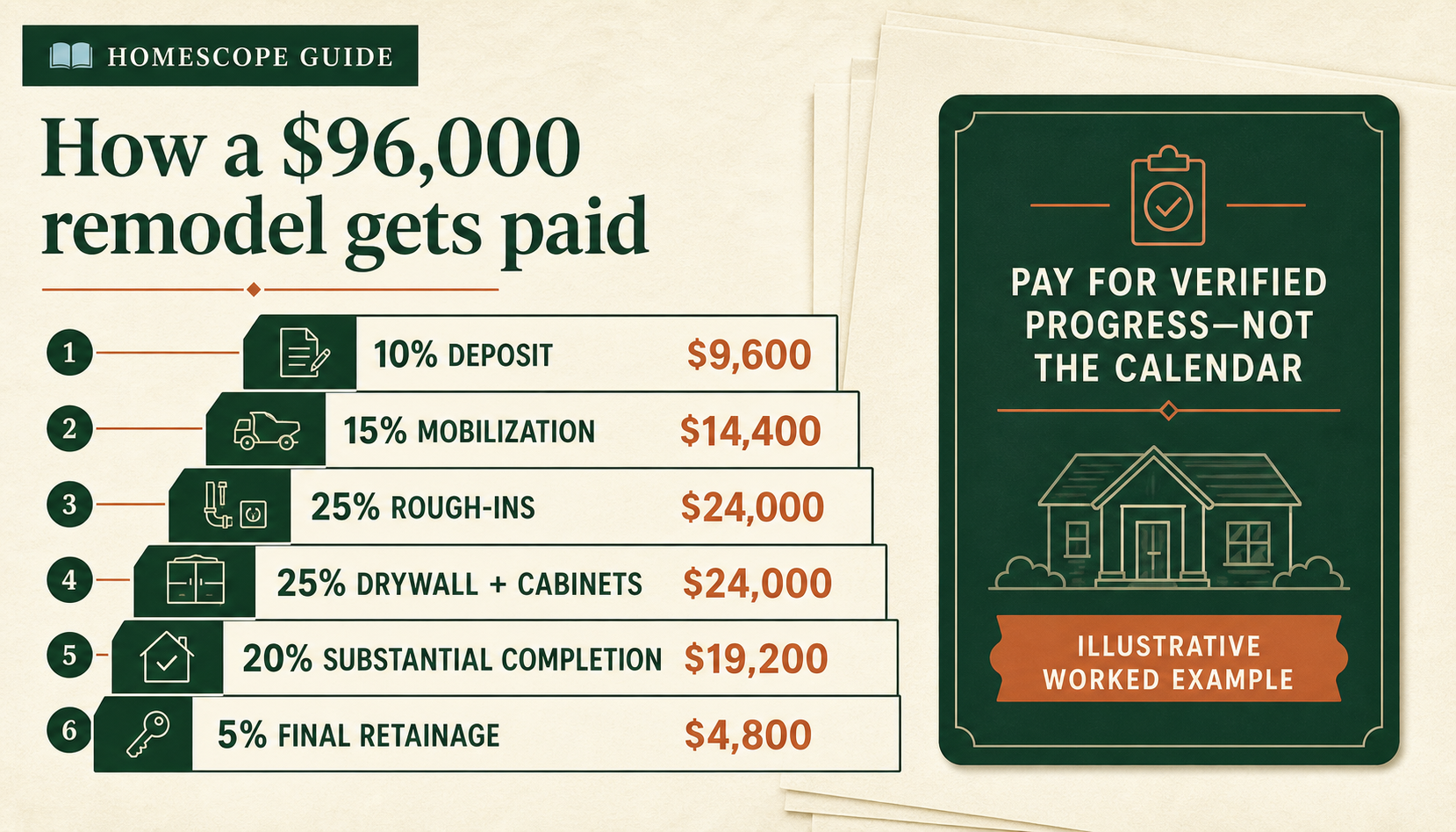
The six payments total 100%. The labels are only useful when the written agreement also defines the observable trigger for each one.
Constructed $96,000 example
Six payments. Six observable decisions.
Deposit
Trigger: After signing; before work begins
Evidence: Contract execution, scheduling, and only the specifically named early commitments.
Mobilization
Trigger: After site setup and named materials are delivered
Evidence: Site protection, dumpster or staging, and materials confirmed on site, not merely ordered.
Rough-ins
Trigger: After rough plumbing/electrical/mechanical work and required inspection approval
Evidence: The milestone is observable and the applicable inspection result is recorded.
Drywall + cabinets
Trigger: After drywall finishing and cabinet installation
Evidence: Both named work blocks are substantially installed; incomplete items are written down.
Substantial completion
Trigger: After fixtures operate and the punch list is created
Evidence: The project can be used for its intended purpose, subject to documented corrections.
Final retainage
Trigger: After punch list, final inspection if required, and closeout records
Evidence: Agreed corrections, approvals, warranties, lien waivers, and final records are complete.
This is a constructed educational example. The percentages, amounts, sequence, milestone language, retainage, and closeout documents are illustrative. They are not observed contract terms, Michigan requirements, legal advice, or a recommendation for every project.
Two different jobs
A deposit signs the deal. Mobilization should show something changed.
Combining both into a vague 25% “start payment” hides what the second payment actually buys. Keep the two decisions separate and require visible evidence before the mobilization payment becomes due.
Inspection-linked milestone
“Rough-ins complete” and “inspection approved” are not identical.
Treat this as a three-part decision. Installed work, the official record, and the payment trigger each need their own written status.
Rough work installed
Plumbing, electrical, and mechanical work covered by the milestone is visibly installed to the written scope.
Required inspection recorded
If the local permit office requires this inspection, record the actual result. HomeScope does not assume approval.
Trigger satisfied or exception written
If work or approval is incomplete, write down the exception and revised trigger instead of paying ahead without a record.
Pressure-test the schedule
Six warning signs worth resolving in writing.
Large front-loaded payment
A high early percentage is not explained by named commitments, delivered materials, or observable work.
Calendar-only billing
Money is due on a date even if the corresponding work is incomplete.
“Materials ordered” alone
The agreement does not name the items, ownership, delivery status, storage, or refund treatment.
Inspection timing ignored
A covered-work payment can become due before a required inspection result is known.
No meaningful holdback
Almost all money is paid before punch-list, approval, warranty, and closeout records are complete.
Change orders bypass the schedule
Added work creates immediate payment demands without a signed price, schedule effect, or new milestone.
Use outside HomeScope
Normalize each payment before you sign.
The printable worksheet gives every milestone one row for percent, dollars, work trigger, evidence, inspection dependency, exceptions, and approval. It also includes a 100% arithmetic check and a payment-event log.
Approaching the last payment? Continue with the remodel closeout and final-payment checklist to reconcile the punch list, approvals, records, and remaining balance.
Continue the decision
Test the proposed payment schedule.
Enter every stage once to expose front-loading, vague triggers, missing evidence, and a weak closeout holdback.